
C and Z purlins used in steel buildings are available in many different dimensions. Warehouses, industrial workshops, roofing systems, wall supports and solar mounting structures may require different web heights, flange widths, lip dimensions and punching positions.
Replacing a complete set of forming rollers whenever a new profile is required can increase setup time, tooling costs and manual work. A 100–300mm adjustable CZ purlin machine is designed to produce multiple profile sizes on one production line by moving the forming sections, changing the distance between the rollers and adjusting the C/Z conversion mechanism.
This flexible configuration makes the CZ purlin roll forming machine suitable for manufacturers that receive orders with different specifications and production quantities.
-压缩-1024x1024.jpg)
What Does the 100–300mm Range Mean?
On a C Z purlin machine, the 100–300mm range normally refers to the adjustable web height of the finished purlin.
For example, when the customer needs to produce purlins with a web height of 100mm, 150mm, 200mm or 300mm, the forming sections can be moved to the corresponding positions. The material then passes through several roll forming stations and is gradually shaped into the required profile.
However, the 100–300mm range does not mean that every dimension of the profile can be changed freely. The flange width, lip size, material thickness and punching range still depend on the roller design and the customer’s profile drawings.
Typical specifications of an adjustable CZ purlin roll forming machine may include:
- Adjustable web height: 100–300mm
- Material thickness: 1–3mm
- Finished profiles: C purlins and Z purlins
- Standard forming speed: 0–25m/min
- High-speed version: above 25m/min available
- Cutting method: stop cutting or servo tracking cutting
- Control system: PLC with touch-screen operation
The final technical configuration should be designed according to the profile dimensions, material strength and required production capacity.
How Does an Adjustable CZ Purlin Machine Change the Profile Size?
A fixed-size purlin machine normally has stationary forming rollers and is designed for one profile or several similar sizes.
An adjustable CZ purlin machine usually adopts a split forming structure. The left and right forming sections can move horizontally along the machine base. When the distance between the two forming sides changes, the web height of the finished purlin changes accordingly.
The main purpose of this design is not to replace all forming rollers. Instead, the existing forming units are repositioned to match a new profile size.
For steel structure manufacturers handling multiple orders, this design can reduce tooling changes and make the production schedule more flexible.

Which Parts Must Be Adjusted During a Size Change?
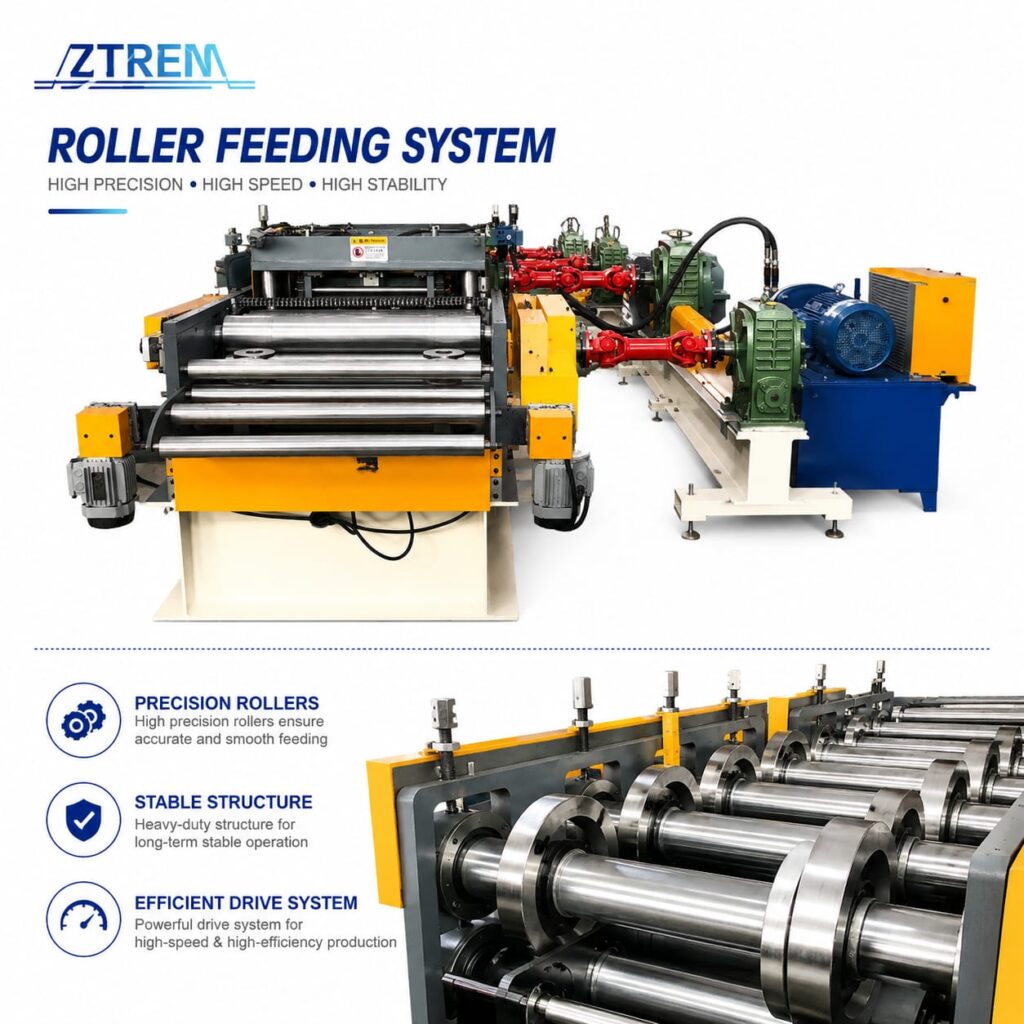
Changing from one purlin size to another requires more than entering a new value into the PLC. The forming machine, feeding guide, straightening system and cutting unit must work together to produce the correct profile.
Position of the Forming Frames
The web height is mainly determined by the distance between the left and right forming sections.
When the target size changes, the movable forming frames must be repositioned. The adjustment system may include lead screws, gear reducers, encoders or servo systems.
On a manually adjustable machine, the operator moves the forming section by handwheel or control button and checks the position using a scale or adjustment chart.
On an automatic CZ purlin roll forming machine, the operator enters or selects the required size on the touch screen. The control system then moves the forming stations to their preset positions.
Feeding Guide Position
After the profile size is changed, the material feeding position must also be checked.
The feeding guide keeps the strip aligned with the centerline of the forming machine. If the guide is not adjusted correctly, the finished profile may have unequal dimensions on both sides, edge deformation or material deviation.
The strip centerline should therefore remain aligned with the forming centerline after every size change.
Forming Roller Positions
A C or Z purlin is not formed in one step. The strip passes through multiple roller stations, which gradually create the web, flanges and lips.
After adjusting the machine width, all forming stations must remain properly aligned. If some roller stations are not synchronized, uneven pulling forces may cause twisting, side bending or surface scratches.
An automatic adjustable CZ purlin machine generally uses a linked adjustment structure so that multiple forming stations move together. A manual machine requires the operator to check the relevant positions according to the adjustment procedure.
Straightening Unit
Cold roll forming is affected by material thickness, hardness and springback.
After changing the profile size, the outlet straightening unit should be checked again. Small adjustments to the straightening rollers can help correct upward bending, downward bending or lateral deviation.
Cutting Die
The cutting system must match the cross section of the finished purlin.
When the web height changes, the working position of the cutting die must also be adjusted. On some CZ purlin production lines, the cutting unit moves together with the forming machine. Other machines require manual positioning.
When the same machine produces both C and Z purlins, the cutting die must also be designed to accommodate both profile shapes.

How Are C and Z Purlins Changed on the Same Machine?
C and Z purlins have similar cross sections, but their flanges face in different directions.
Both flanges of a C purlin face the same direction, while the flanges of a Z purlin face opposite directions. Therefore, changing from a C profile to a Z profile requires both a size adjustment and a change in the forming direction on one side of the machine.
The two common C/Z conversion methods are manual conversion and automatic conversion.
Manual C/Z Conversion
After the machine is stopped, the operator adjusts or turns over selected forming rollers or conversion components. This changes the forming direction on one side of the profile.
Manual conversion has a relatively simple structure and lower equipment cost. It is suitable for factories that do not frequently change between C and Z purlins.
Automatic C/Z Conversion
An automatic C Z purlin roll forming machine integrates part of the conversion process into the PLC control system.
The operator selects C purlin mode or Z purlin mode on the touch screen, and the machine adjusts the relevant forming components according to the stored program.
Automatic conversion is more suitable for manufacturers producing multiple profile types and frequently changing production orders.
After either manual or automatic conversion, a short test profile should be produced. The operator should check the profile direction, cross-sectional dimensions, flange angles and overall straightness before starting continuous production.
Complete Size Change Procedure
Confirm the Profile Drawing
Before changing the machine setup, the operator should confirm the new profile specifications, including:
- Web height
- Flange width
- Lip dimension
- Material thickness
- C or Z profile type
- Finished length
- Hole shape and punching position
If the new profile is outside the designed working range of the machine, it cannot be produced by adjustment alone. The roller and tooling design may need to be reviewed.
Enter the Target Size
On an automatic 100–300mm CZ purlin machine, the operator can enter the required dimensions or select a saved production recipe on the touch screen.
The PLC controls the adjustment system and moves the forming stations to the corresponding positions.
On a manually adjustable machine, the operator positions each section according to scales or an adjustment chart.
Check the Mechanical Positions
After the adjustment is complete, the forming frames, feeding guides, rollers, straightening device and cutting system should be inspected.
The value displayed on the touch screen should not be the only reference. When a new profile is produced for the first time, the main mechanical positions should also be checked manually.
Fine-Tune the Machine
If there is a small difference between the sample and the drawing, the feeding guide, forming rollers or straightening unit can be fine-tuned.
Material hardness, yield strength and springback affect the final shape. Even when producing the same profile size, a new material batch or a different steel supplier may require additional adjustment.
Manual Adjustment or Automatic Adjustment?
The correct adjustment method depends on the factory’s production plan and order structure.
A manually adjustable CZ purlin machine is suitable when:
- Only a few sizes are commonly produced
- C/Z conversion is not frequent
- Production plans are relatively stable
- The buyer wants to control the initial investment
- Skilled operators are available
An automatic adjustable CZ purlin roll forming machine is more suitable when:
- Many C and Z purlin sizes are required
- Order specifications change frequently
- Small-batch and multi-size orders are common
- The factory wants to reduce manual setup time
- Faster and more convenient size changes are required
Automatic adjustment improves operational convenience, but it does not eliminate the need for testing and measurement. The finished profile must still be checked whenever the material thickness, strength or supplier changes.
Why Is Test Production Necessary After Adjustment?
The forming sections of a CZ purlin roll forming machine can move according to preset dimensions, but the final profile is still affected by the properties of the steel.
Two materials with the same nominal thickness may have different hardness, yield strength, coating thickness and surface conditions. These differences can change springback and forming resistance.
After adjustment, test production should confirm:
- Cross-sectional dimensions
- Flange symmetry
- Lip angles
- Overall straightness
- Punching position
- Finished length
- Cutting quality
Starting mass production only after testing and fine adjustment can reduce the risk of producing a large quantity of out-of-tolerance profiles.
Zhongtuo can design the forming rollers, size adjustment system, punching solution and cutting method according to the customer’s profile drawings and production requirements.
For a high-speed CZ purlin production line, the main drive, servo feeding system and servo tracking cutting system should also be matched as one complete solution.
Conclusion
A 100–300mm adjustable CZ purlin machine changes the finished web height by moving the left and right forming sections. Together with the feeding guide, straightening unit, cutting system and C/Z conversion mechanism, one line can produce multiple C and Z purlin specifications.
A size change is not completed by changing one PLC value alone. It requires mechanical adjustment, control parameter setting, test production and final inspection.
A properly designed CZ purlin roll forming machine can reduce full roller replacement, improve production flexibility and help manufacturers handle different steel structure orders. Stable finished quality still depends on accurate profile drawings, suitable roller design and standardized machine adjustment procedures.