
A CZ Purlin Roll Forming Machine is an important production solution for manufacturers supplying C and Z steel purlins to steel buildings, industrial workshops, warehouses, logistics centers, roofing structures, and prefabricated construction projects.
When choosing a purlin production line, forming speed is only one part of the evaluation. Machine frame strength, roller accuracy, transmission design, punching configuration, cutting method, PLC control, and hydraulic performance can all influence the quality of the finished profiles.
A properly designed CZ Purlin Production Line can provide consistent dimensions, flexible profile production, reliable continuous operation, and lower dependence on manual adjustment.
This article explains the main components of a modern C Z Purlin Roll Forming Machine, their functions, and how they work together during the complete manufacturing process.

1. Hydraulic Decoiler for Stable Coil Feeding
Production begins with the decoiling section.
The decoiler supports the steel coil and releases the material continuously into the next processing stage. Stable unwinding is important because excessive tension or irregular feeding can affect the alignment of the steel strip before forming.
Depending on coil weight, production capacity, and customer requirements, different decoiler configurations can be selected.
For industrial applications, a hydraulic expansion decoiler can make coil loading and clamping more convenient while providing stable material feeding for the steel purlin production line.
2. Feeding and Guiding System
Before the steel strip enters the main forming section, it needs to be correctly aligned.
The feeding and guiding system controls the material position and keeps the strip traveling along the required production centerline.
Incorrect feeding may cause profile asymmetry, dimensional deviation, or unstable forming.
For this reason, the guiding device of a C Purlin Making Machine is normally designed according to the raw material width and finished profile specifications.
A properly adjusted feeding system provides a reliable foundation for the following punching and forming processes.
3. Material Leveling Unit
Steel coils may develop slight curvature or unevenness during storage, transportation, and decoiling.
A leveling unit helps correct the incoming strip before it reaches the forming rollers.
Flatter material improves feeding stability and can reduce twisting, bending, and dimensional variation in the finished purlin.
This section becomes particularly important when producing thicker steel profiles or when a project requires higher dimensional consistency.
4. Automatic Punching System
C and Z purlins are often designed with installation holes for connection to steel building structures.
An automatic punching unit can therefore be integrated into the CZ Purlin Roll Forming Machine according to the customer’s drawings.
The punching pattern can be customized based on:
- Hole position
- Hole spacing
- Hole quantity
- Profile specification
- Construction requirements
With PLC control, punching positions can be coordinated with material feeding and preset production lengths.
Integrating the punching process into the production line reduces secondary processing and helps manufacturers improve production efficiency.
5. Main Roll Forming Section
The roll forming section is the core of the entire CZ Purlin Making Machine.
Instead of bending the steel strip into its final shape in a single operation, the material passes through a sequence of roller stations.
Each forming station gradually changes part of the profile until the required C or Z shape is completed.
This progressive cold forming process helps control material deformation and contributes to stable profile geometry.
Zhongtuo designs the number and arrangement of forming stations according to several factors, including:
- Finished profile drawing
- Material thickness
- Steel properties
- Purlin dimensions
- Required forming accuracy
For common steel structure applications, the machine can be designed to process materials with a thickness of approximately 1–3 mm, with other specifications available according to project requirements.

6. Precision Forming Rollers
The forming rollers are among the most important components affecting finished profile quality.
Roller geometry, machining accuracy, hardness, and surface treatment all influence the forming result.
Precision rollers help control important areas of the profile, including the web, flange, and lip dimensions.
On a professional Z Purlin Forming Machine, the roller arrangement should be developed according to the cross-sectional geometry of the finished product rather than using a universal forming design.
A suitable roller configuration can help reduce:
- Profile twisting
- Dimensional variation
- Surface scratching
- Unstable flange angles
- Excessive material deformation
This is particularly important for manufacturers producing purlins continuously over long production cycles.
7. Stable Transmission System
The transmission system transfers power from the drive unit to the forming stations.
Its design has a direct influence on machine stability and synchronization.
A properly configured transmission system helps maintain consistent roller rotation throughout the forming process.
This can reduce unnecessary vibration and improve operating stability, especially when the steel purlin making machine is processing thicker materials.
Reliable power transmission is therefore an important consideration when evaluating the long-term performance of a roll forming line.
8. Main Motor and Drive Unit
The main motor provides the power required for continuous roll forming.
Motor capacity should be selected according to the profile design, steel thickness, number of forming stations, transmission structure, and required production speed.
Simply installing a larger motor does not automatically provide better machine performance.
The motor, gearbox, shafts, and transmission system should work as a complete drive solution.
Proper power matching helps reduce unnecessary mechanical loads and supports stable operation during continuous production.
9. PLC Automatic Control System
Automation is an important part of a modern Automatic CZ Purlin Roll Forming Machine.
The PLC control system allows operators to manage major production parameters through a touch-screen interface.
Depending on machine configuration, the system can control:
- Finished product length
- Production quantity
- Forming speed
- Punching position
- Cutting position
- Production parameters
- Equipment operating status
Automatic control reduces repeated manual measurement and adjustment while improving consistency between production batches.
For manufacturers handling different orders and purlin specifications, an organized PLC system also simplifies daily machine operation.
10. Flexible C and Z Purlin Production
One of the main reasons manufacturers select a C Z Purlin Roll Forming Machine is production flexibility.
The line can be designed to produce different C and Z profile specifications according to project requirements.
This allows steel structure manufacturers to respond to changing orders without installing a separate production line for every individual purlin size.
Depending on the equipment configuration, adjustments can be made for different profile widths, heights, lips, and other dimensional requirements.
Flexible production can improve machine utilization and make the production line more suitable for manufacturers serving multiple steel construction projects.
11. Cutting System
Once the purlin reaches the preset length, it needs to be cut accurately.
Different cutting solutions can be selected according to production capacity, efficiency requirements, and investment budget.
Stop Cutting System
With stop cutting, material feeding pauses briefly while the cutting operation is completed.
This configuration has a relatively straightforward structure and is suitable for conventional purlin production.
It is commonly selected by manufacturers that prioritize practical operation and convenient maintenance.
Servo Tracking Cutting System
A Servo Tracking Cutting System moves together with the profile during cutting.
The line can therefore maintain more continuous material movement and reduce interruptions caused by repeated stopping.
This solution is suitable for customers who require higher production efficiency and smoother continuous operation.
Choosing between stop cutting and servo tracking cutting should be based on actual production targets rather than selecting a system only by price.
12. Hydraulic Power System
The hydraulic station supplies power to functions such as punching and cutting.
Stable hydraulic pressure is essential for maintaining consistent machine movements during repeated production cycles.
The hydraulic unit should be matched to the production line configuration, punching requirements, and cutting structure.
A properly designed hydraulic system contributes to reliable operation and reduces unnecessary production interruptions.
13. Run-Out Table and Finished Product Support
After cutting, the finished purlins move to the discharge section.
A run-out table or supporting frame receives the profiles and helps maintain an organized production flow.
When producing long C or Z purlins, sufficient product support can also reduce deformation caused by the weight of the finished section.
The discharge configuration can be customized according to profile length and customer workshop requirements.
14. Complete CZ Purlin Production Process
A complete CZ Purlin Production Line is not simply a collection of independent machines.
Each component needs to operate in coordination with the others.
A typical production process includes:
Decoiling → Feeding → Leveling → Punching → Roll Forming → Length Cutting → Finished Product Collection
Stable synchronization between these processes has a direct impact on production efficiency and profile quality.
Accurate feeding supports accurate punching. Accurate punching needs to match the preset production length, while stable forming and cutting ensure that the final purlin meets the required dimensions.
This is why overall production line design is often more important than evaluating one individual component.

15. Why Machine Configuration Matters
Two CZ Purlin Roll Forming Machines may look similar from the outside, but their actual production performance can be very different.
When comparing equipment, manufacturers should pay attention to factors such as:
- Machine frame rigidity
- Forming roller accuracy
- Shaft strength
- Transmission structure
- PLC control configuration
- Cutting technology
- Hydraulic components
- Electrical components
- Production line layout
- After-sales technical support
Machine price and maximum forming speed alone cannot fully represent equipment quality.
A properly engineered Cold Roll Forming Machine can create greater long-term value by improving production consistency, simplifying maintenance, and reducing unexpected downtime.
16. Customized CZ Purlin Roll Forming Solutions from Zhongtuo
Different steel construction markets have different requirements for purlin sizes, material thicknesses, punching layouts, production speed, and finished product standards.
For this reason, Zhongtuo develops customized CZ Purlin Roll Forming Machine solutions according to the customer’s actual production requirements.
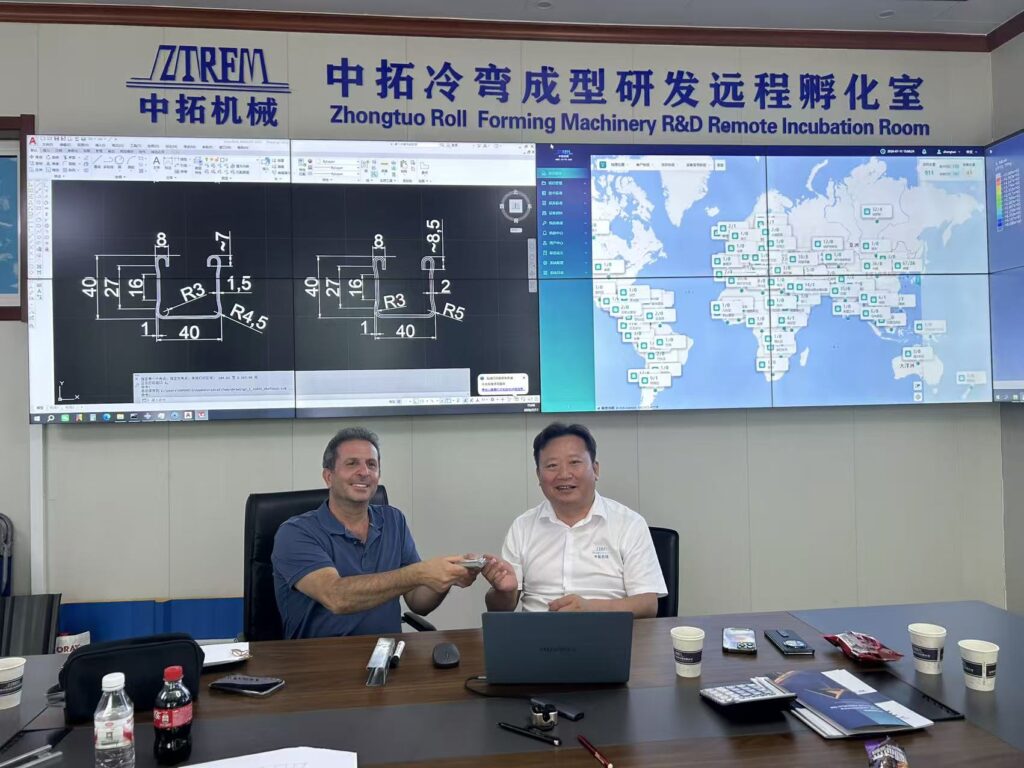
Before machine manufacturing begins, our technical team can analyze the customer’s profile drawing and determine a suitable forming solution.
The project process can include:
- Profile drawing analysis
- CAD drawing confirmation
- Machine configuration planning
- Roll forming line manufacturing
- Factory machine testing
- Installation guidance
- Operator training
- Remote technical assistance
- After-sales support
Instead of applying one standard machine configuration to every project, we focus on matching the equipment structure to the customer’s finished profile and production conditions.
This approach helps customers build a more practical and reliable purlin manufacturing system.
Choosing the Right CZ Purlin Machine for Your Factory
Before purchasing a CZ Purlin Roll Forming Machine, manufacturers should clearly define their production requirements.
Important information normally includes:
- C and Z purlin drawings
- Steel thickness range
- Raw material type
- Required profile dimensions
- Punching requirements
- Expected production speed
- Cutting method
- Electrical standard
- Workshop layout
Providing complete technical information allows the equipment manufacturer to design a production line that better matches the actual project.
This can also reduce unnecessary modifications after machine production has already started.
Conclusion
Understanding the main components and working process of a CZ Purlin Roll Forming Machine makes it easier to evaluate equipment before purchasing.
From decoiling, feeding, and leveling to punching, roll forming, PLC control, and precision cutting, every section contributes to the final production result.
A well-designed C Purlin Making Machine or Z Purlin Forming Machine should provide more than finished profiles. It should support stable production, flexible specification adjustment, accurate processing, and reliable long-term operation.
Zhongtuo specializes in the design and manufacturing of steel structure roll forming equipment and provides customized purlin production solutions for different markets and applications.
By combining profile analysis, machine design, manufacturing, testing, technical support, and after-sales service, we aim to help customers establish efficient and reliable steel purlin production systems.